POLICE CASTLE
Police Castle
Police 1
675 34 Police u Jemnice (District of Znojmo)
Czech Republic
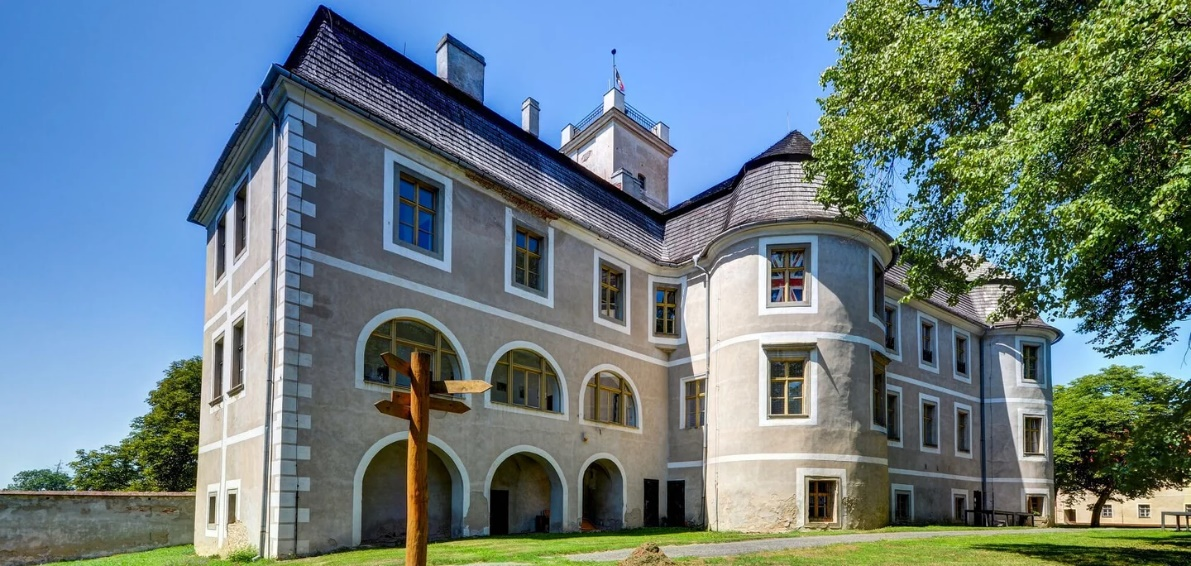
The first evidence of the presence of a noble family in Polička dates back to 1343, while the medieval fortress is mentioned in 13711. The oldest architectural element of the castle is an irregular courtyard, the western part of which appears to be the oldest. An inscription above the courtyard portal states that the building was commissioned in 1534 by the nobleman Jan Tawikowsky, governor of the castle of Znojmo in Police. At this stage, a three-body wing with corner towers was added, one of which still survives today. Modifications to the original plan and the extension take place over a long period. In the south-west tower, a staircase is built giving access to a porticoed pavilion with newly constructed rooms. An inventory from 1678 mentions a chapel, while between 1710 and 1720, a Sala terrena with terrace and portico was built. Between 1679 and 1720, Franz Karel Berchtold (1655-1720) was the owner of the castle and commissioned the decoration of the rooms on the first floor, which is attributed to the workshop of Baldassarre Fontana for stylistic similarity. The exterior of the building dates back to the period between the 18th and the first half of the 19th century, during the Berchtold rule (Fig. 1). Although there are no documents regarding the evolution of the building, a stylistic analysis suggests that significant changes were made around 1790. Since 1996, the castle has been gradually renovated and restored with the involvement, from 2000, of the company ARCHEON Group s.r.o..
First floor, Room 206


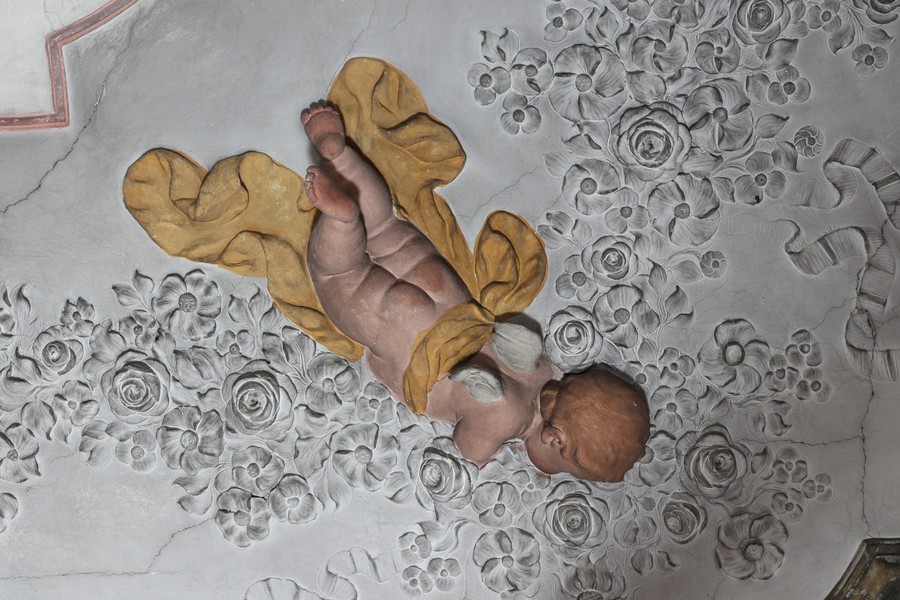
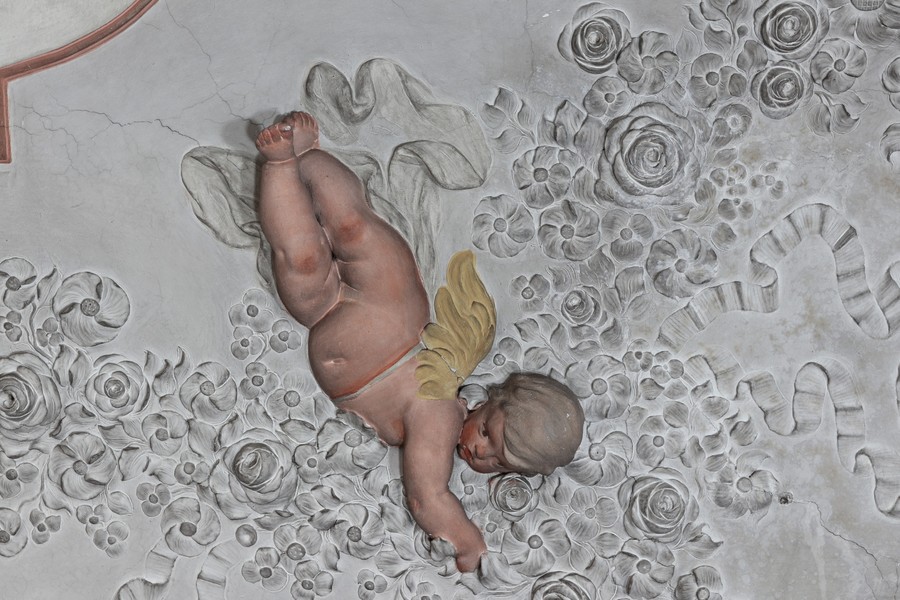
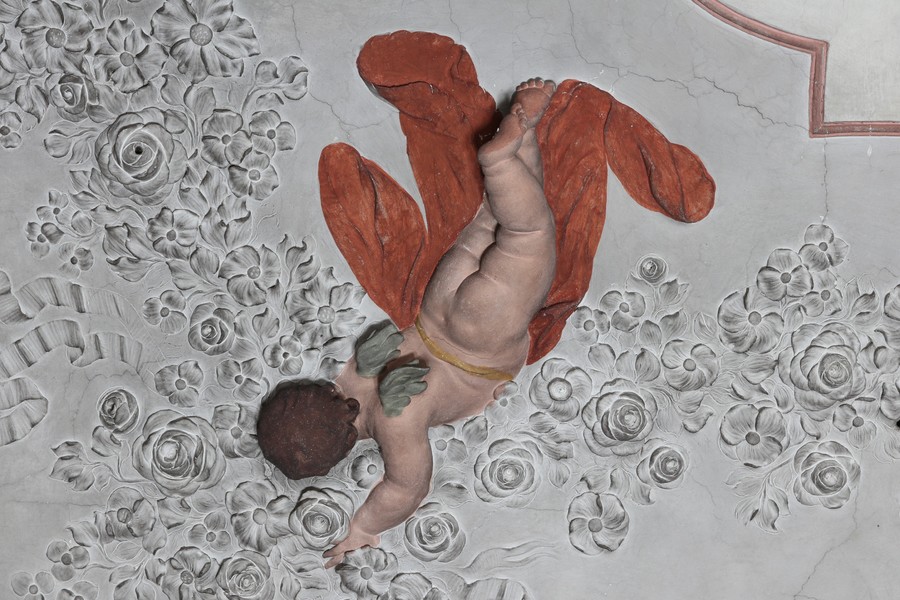
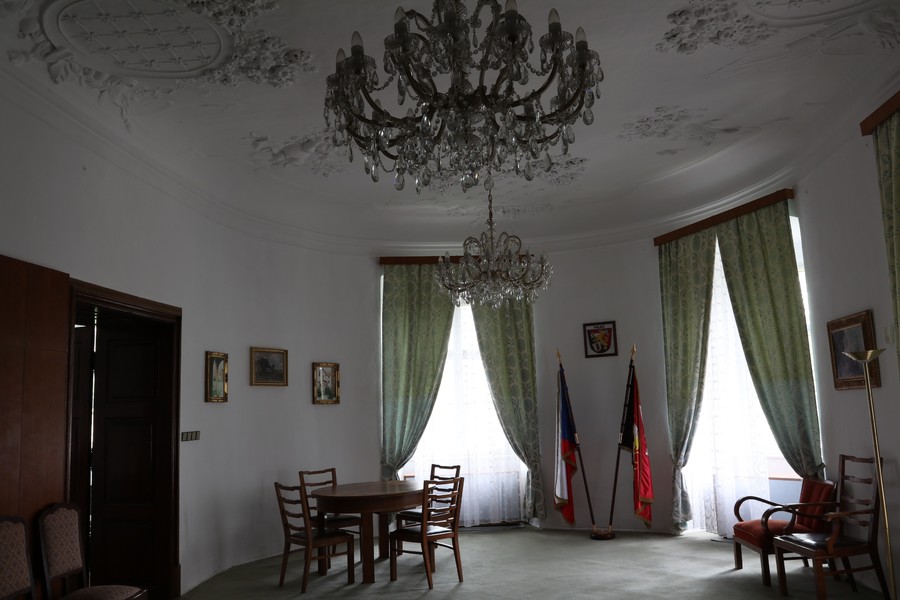
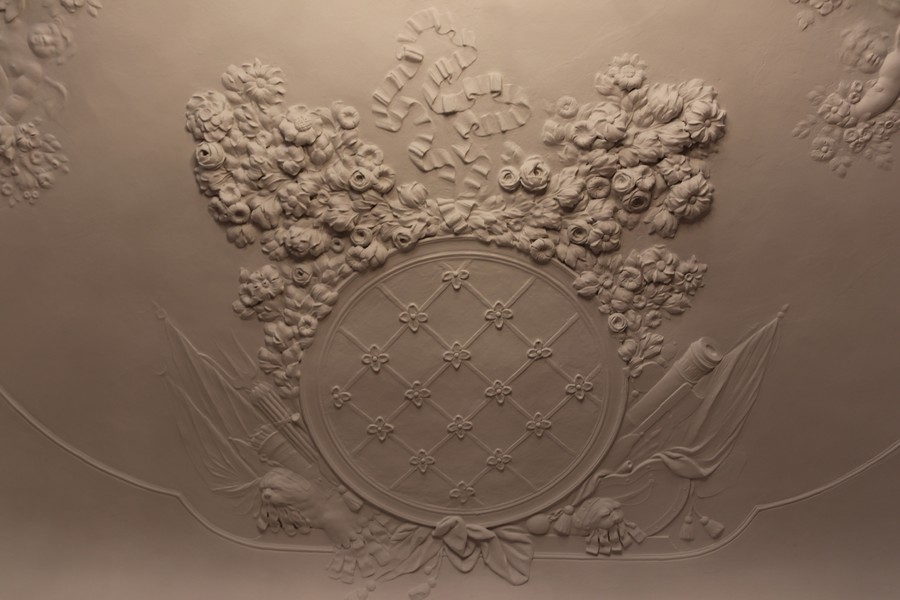
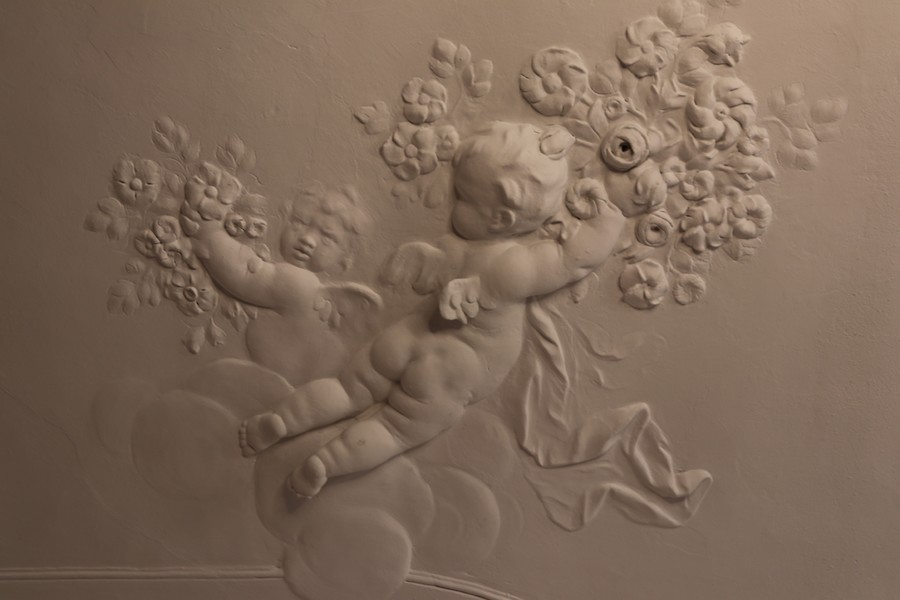
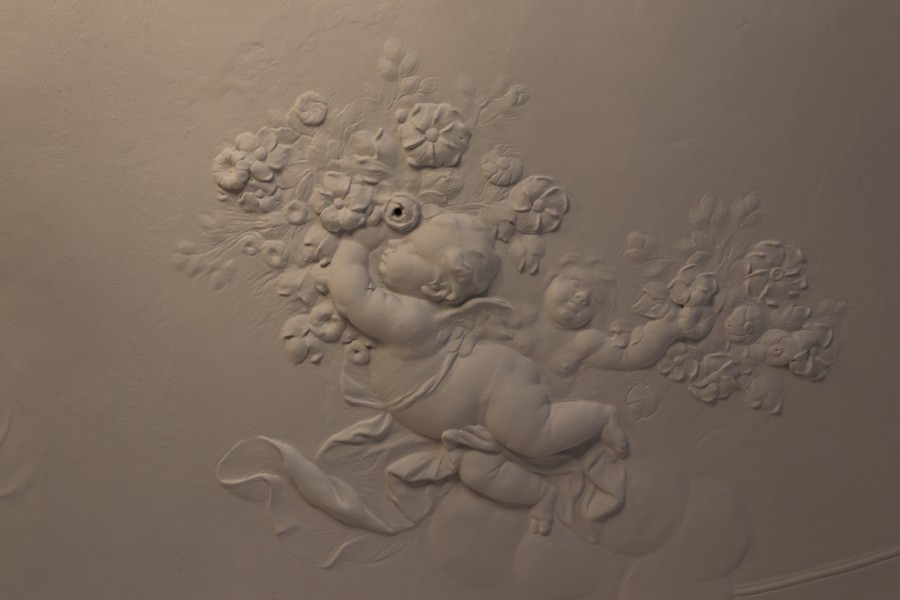
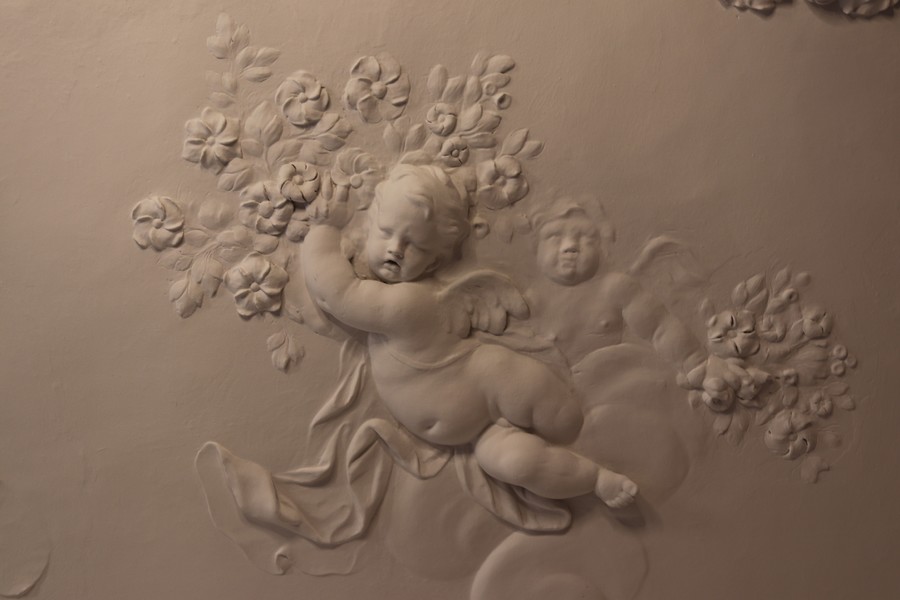
In room 206 the stucco decoration is concentrated on the ceiling (Fig. 2), where there are four medals with grids and rosettes (Fig. 3), crowned by floral decorations arranged in two groups linked by a central ribbon. The lower part depicts war motifs (banners, cannons, guns, targets, but also pitchforks) and an animal, probably a dog. The medals, although similar, show slight variations in decorative motifs. Between them, pairs of putti in high and low relief carry flowers, floating on a cloud with drapery above them (Fig. 4, 5, 6). Thick layers of whitewash are present on the stuccoes.
First floor, Room 207


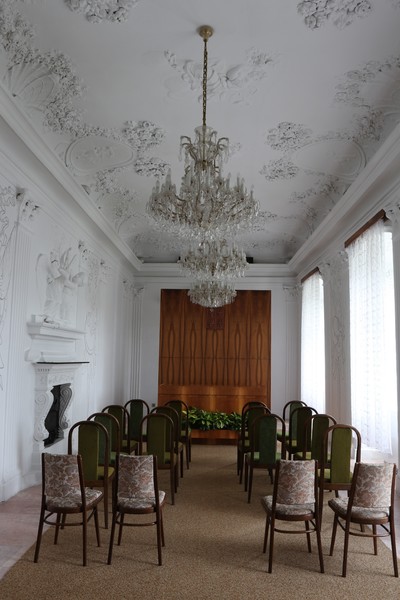
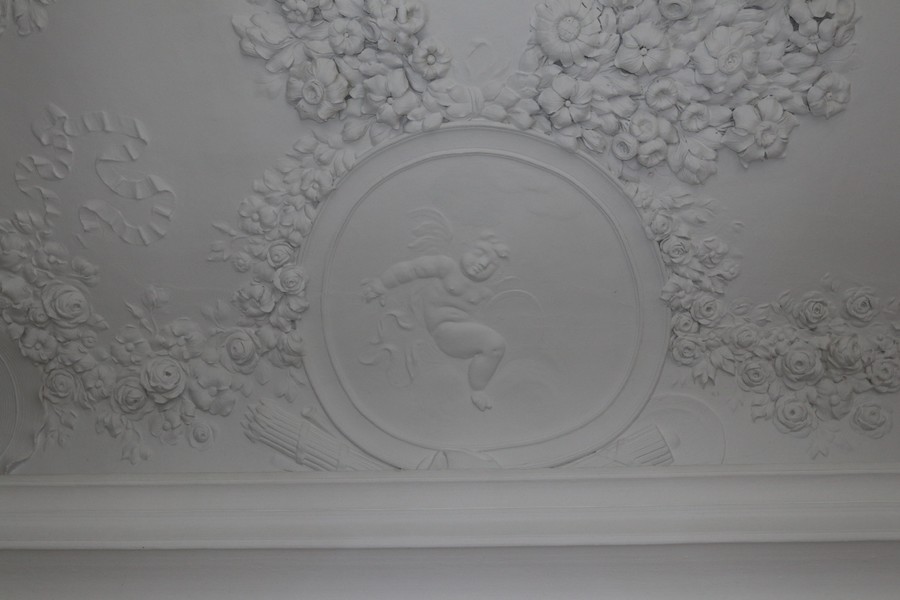
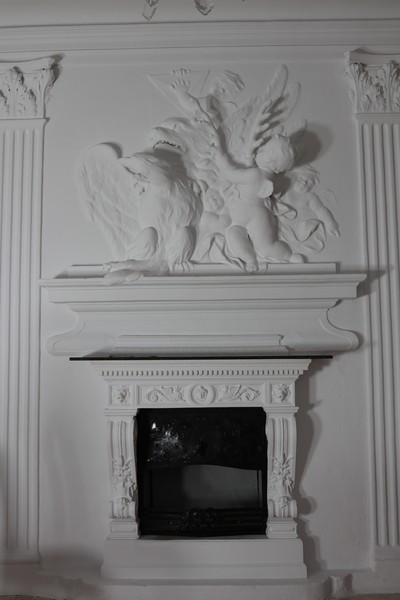
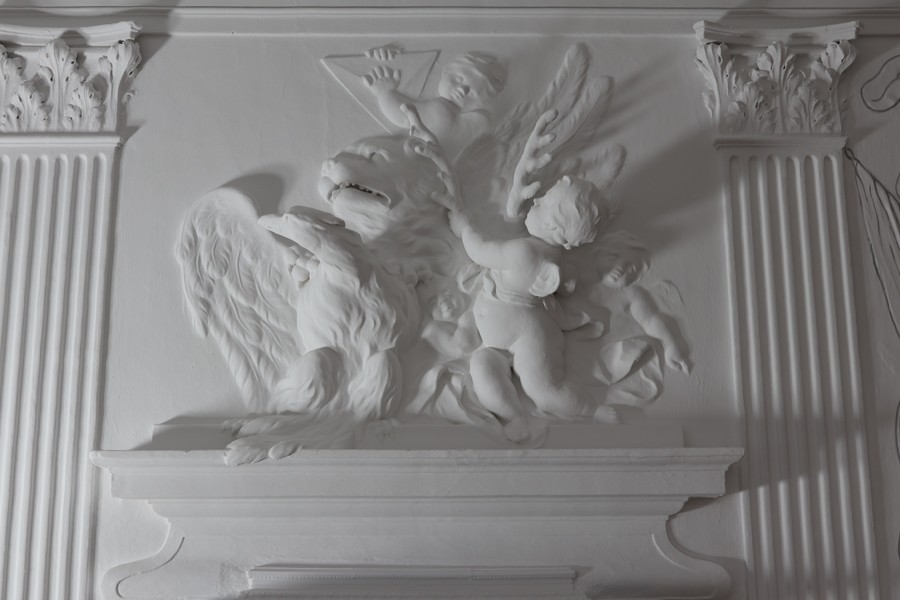
The room is enriched with stucco decoration covering both the ceiling and the walls (Fig. 7). The ceiling is decorated with eight bas-relief stucco medals, each depicting a variant of a putto floating above a draped cloud (Fig. 8), interspersed with shells. As in room 206, the medals are surrounded by floral ornaments at the top, in this case the medals and shells are bound by festoons of flowers. In the centre of the ceiling are three figures: a putto and two female figures seated on a cloud, partially draped with flowers in their hair and hands. Above the door that connects room 206 to room 207, a bust of a woman is set into the pediment. The walls are punctuated by fluted pilasters and capitals decorated with acanthus leaves. The central axis of the west wall is dominated by a chimney flanked by two volutes, above which is a moulded cornice with a putto holding a antlers, an eagle and a lion (Fig. 9, 10): heraldic emblems of the Berchtolds and the Pražmas of Bílkov, in memory of the guardian of the patron's first wife. Other figures of putti and draperies in bas-relief complete the decoration. The stuccoes have been heavily repainted and cannot be observed in all their detail.
First floor, Room 226


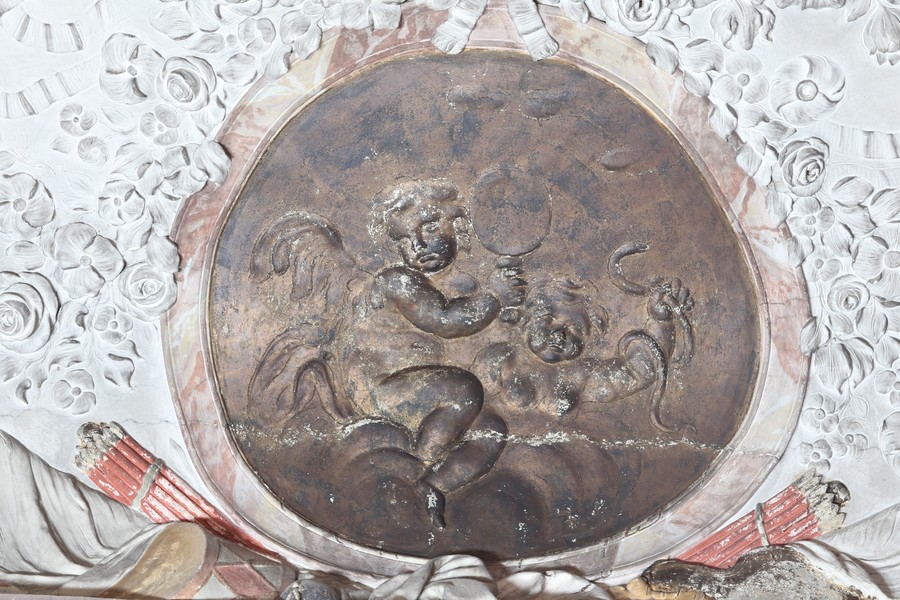
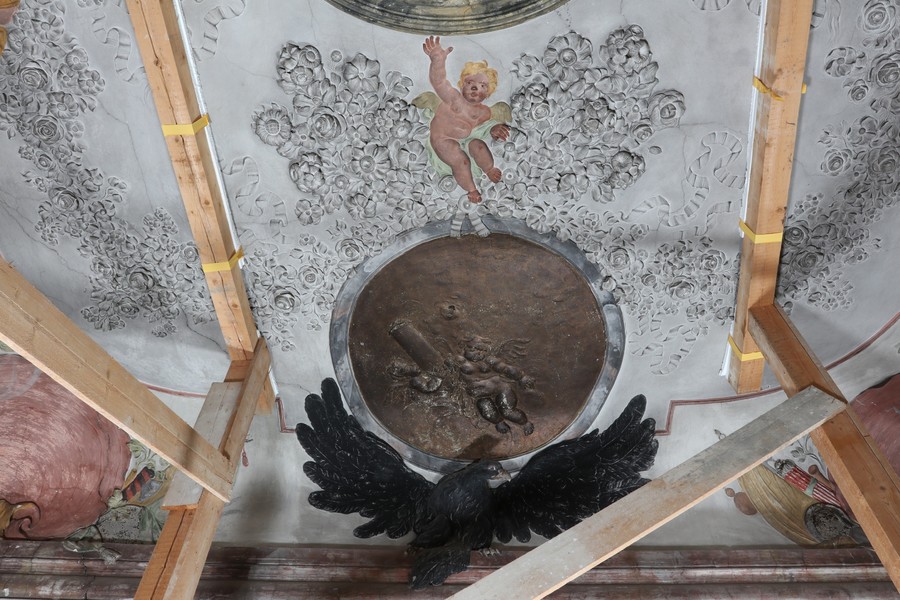
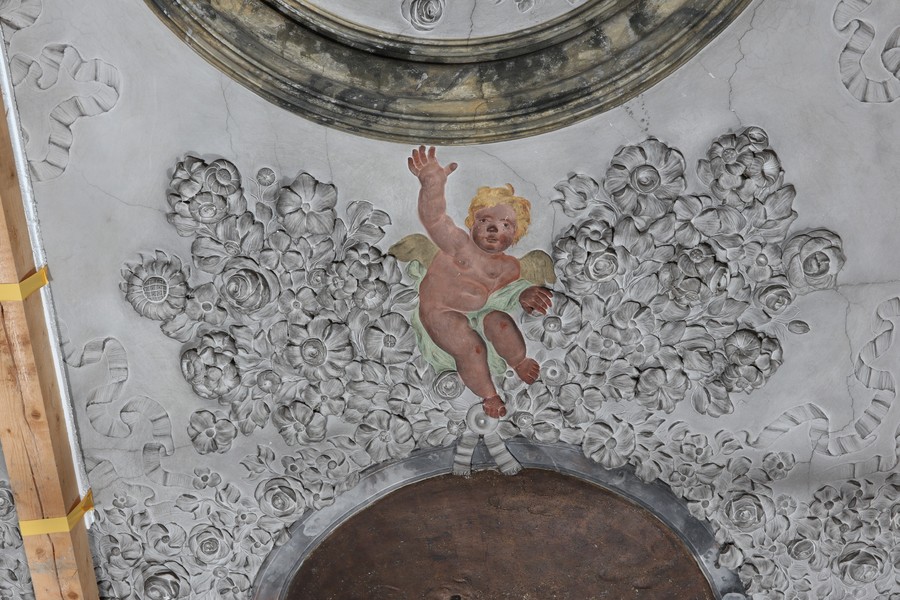
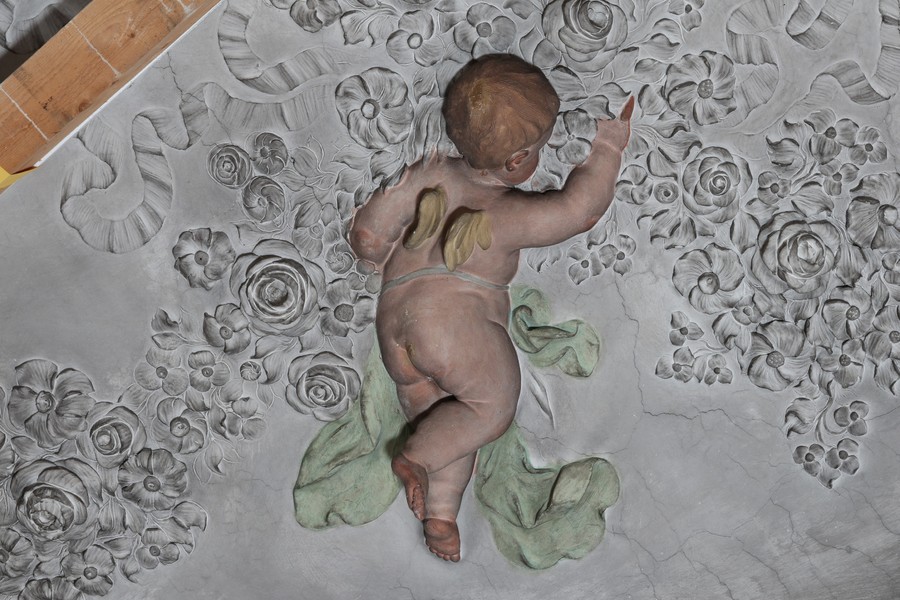
The stucco decoration in room 226 is on the ceiling where, unlike the other rooms, the polychromy of the reliefs has been preserved. These include four stucco medals, arranged along the wall axes, each with a pair of putti floating on a cloud (Fig. 11). The corners of the room are decorated with shell motifs, surrounded by plant and war elements. On the west and east sides, three putti decorate the room (Fig. 12, 13, 14, 15, 16, 17): one above the central medal with an eagle and two near the shells. In the centre of the ceiling, a painting shows the Paris' Judgement surrounded by stucco floral ornaments. The same floral motifs enrich the outside of the frame, connecting the medals to the central mirror, with festoons of flowers intertwined with ribbons, similar to those in room 207. The ceiling underwent structural restoration in 2022 and the stucco decorations were restored the following year.